
Dr. Muzzammil Hussain
Specialization : Business Management
Email : Muzzammil.hussain@uog.edu.pk
Office Number : +(92) 92532260000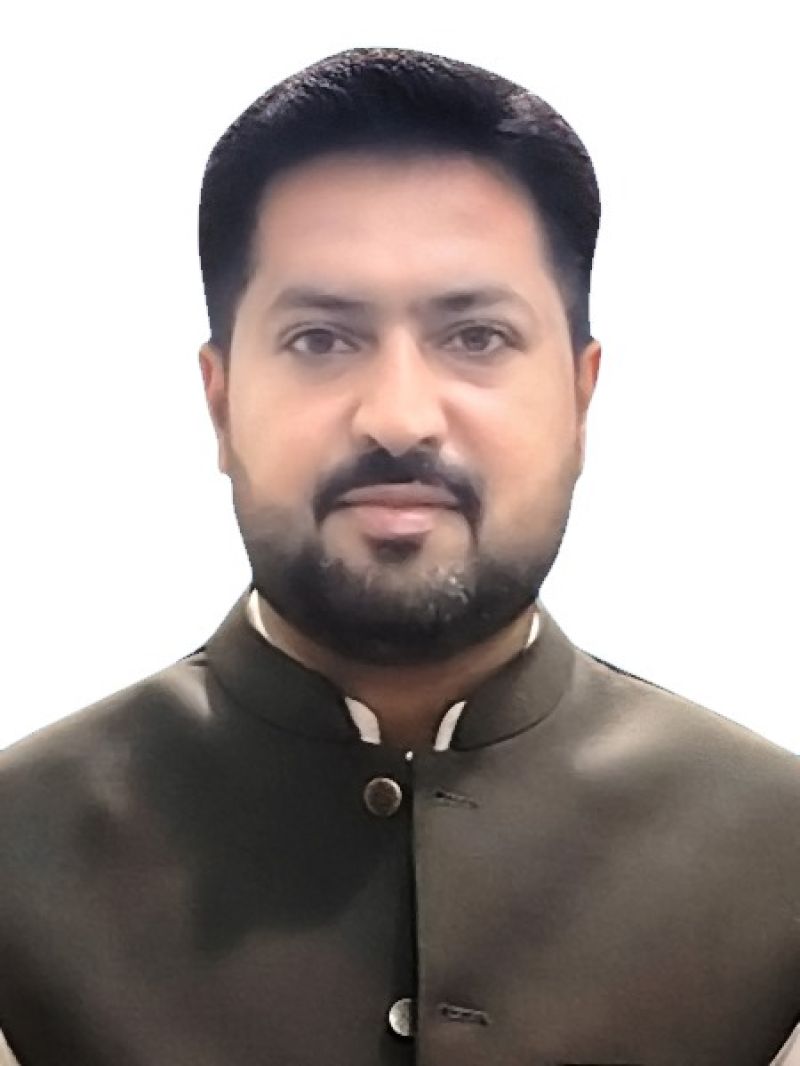
Dr Muzzammil Hussain is an assistant professor in the Department of Commerce at the University of Gujrat, Pakistan, where he has been contributing to the faculty since 2015. He holds a PhD in business management from the University of International Business and Economics, Beijing, China, and brings over 15 years of academic and research experience. Dr Hussain is a highly productive scholar with more than 35 peer-reviewed publications in Q1 and Q2-ranked international journals, including Resources Policy, Journal of Environmental Management, and Environmental Science and Pollution Research. His research focuses on sustainable development, environmental economics, financial management, and financial technology (Fintech), with contributions that have earned him recognition as one of the world's top 2% scientists by Stanford University and Elsevier in 2024. He has received multiple Research Excellence Awards and is an HEC-approved research supervisor dedicated to mentoring graduate and undergraduate students. Dr Hussain teaches courses in macroeconomics, accounting, financial management, and research methodology, integrating cutting-edge research with practical applications. He welcomes collaboration with students and colleagues interested in sustainable development and environmental economics research.
- M.Phil,University of Gujrat
- MBA,University of Punjab
- PhD, Other
- Academic Excellence Award Academic Excellence Award in PhD 2018-19 by UIBE Beijing, China
- Research Excellence Award Highest publications among international scholars in 2019 from UIBE, Beijing, China
- World Top 2% Scientist Stanford University and Elsevier Nominated
- Associate Member Al-Mir Trust Library and Research Center
- 1. MuzzammilHussain, WeiWang(Vivienne), YiwenWang “Natural resources, consumer prices and financial development in China: Measures to control carbon emissions and ecological footprints” Resources Policy, July 2022 DOI:
- 2. XiaoxiaoZhou, MengyuJia, MehmetAltunta?, DervisKirikkaleli, MuzzammilHussain “Transition to renewable energy and environmental technologies: The role of economic policy uncertainty in top five polluted economies” Journal Of Environmental Management, April 2022 DOI:
- 3. Muzzammil Hussain, Zeeshan Arshad & Adnan Bashir “Do economic policy uncertainty and environment-related technologies help in limiting ecological footprint?” Environmental Science And Pollution Research, February 2022 DOI:
- 4. Muzzammil Hussain., Chengang Ye, Chenyun Ye, Yanyan Wang “Impact of financial inclusion and infrastructure on ecological footprint in OECD economies” Environmental Science And Pollution Research, November 2021 DOI:
- 5. Muzzammil Hussain, Nasir Mahmood, Fuzhong Chen, Zeeshan Khan, Muhammad Usman “Comparative re-estimation of environmental degradation and population density in China: Evidence from the Maki’s regime shift approach” Revista De Economia Mundial, August 2021 DOI:
- 6. Muzzammil Hussain, Zhiwei Ye, Adnan Bashir, Naveed Iqbal Chaudhry, Yingjun zhao “A nexus of natural resource rents, institutional quality, human capital, and financial development in resource-rich high-income economies” Resources Policy, August 2021 DOI:
- 7. F Chen, Muzzammil Hussain, JA Khan, Ghulam Mustafa Mir, Z Khan “Voluntary disclosure of greenhouse gas emissions by cities under carbon disclosure project: A sustainable development approach” Sustainable Development, July 2021 DOI:
- 8. Muzzammil Hussain, Jawad Ahmad Khan “The nexus of environment-related technologies and consumption-based carbon emissions in top five emitters: empirical analysis through dynamic common correlated effects estimator” Environmental Science And Pollution Research, July 2021 DOI:
- 9. Muzzammil Hussain, Eyup Dogan “The role of institutional quality and environment-related technologies in environmental degradation for BRICS” Journal Of Cleaner Production, April 2021 DOI:
- 10. Fakhri Javanshir Hasanov, Zeeshan Khan, Muzzammil Hussain, Muhammad Tufail “Theoretical Framework for the Carbon Emissions Effects of Technological Progress and Renewable Energy Consumption” Sustainable Development, February 2021 DOI:
| Date | Title | Agency/Organization | Amount | Status |
|---|---|---|---|---|
| 2023-01-01 | Measures to achieve carbon neutrality: What is the role of energy structure, infrastructure, and financial inclusion | National Social Science Foundation of China | RMB 180,000 | Completed |